How to Choose a Fence in Winnipeg: Start With How You Actually Use Your Yard
The fastest way to choose a fence in Winnipeg is to stop comparing materials and start describing how you use your yard. Write down who and what needs to be contained, what you want screened and from where, which side people actually see, and how much upkeep you will realistically do. Once those four answers exist, the material, height and style stop being a debate and become a consequence. Most fences people regret were chosen from a materials list rather than from a use case.
Almost everyone starts in the same place: wood or chain link, five foot or six foot, horizontal or vertical. It feels like the right question because it is the question every website answers.
It is the wrong place to start. I have quoted plenty of Winnipeg yards where the homeowner had settled on a material before working out what the fence was actually for, and then had to unwind the decision when the purpose became clear. Working the other way round is faster and produces better fences.
Here is the order I would go in.
At a Glance
- Start with containment: dogs, kids, or nothing at all
- Then screening: what you want blocked, and from which viewpoint
- Then visibility: which runs are seen from the street and which are not
- Then upkeep: be honest about what you will actually maintain
- Different runs on the same yard can reasonably be built differently
- Manitoba climate affects how a fence is built more than what it is made of
- Confirm height and placement rules with the City before finalizing anything
- Material comes last, not first, and it will be obvious by then
What is the first question I should actually answer?
What has to stay inside the fence? Containment sets the minimum height and the maximum gap, and everything else has to fit around those two constraints.
A fence for a large dog that jumps is a different fence from one for a small dog that squeezes, which is different again from one for a toddler. If the honest answer is nothing needs containing and this is purely about boundary and appearance, that opens up options that would otherwise be off the table, including much more open styles.
How do I work out how much privacy I actually need?
Go and stand where you sit in the yard, then look at what bothers you. Privacy is directional, and most people only need it along one or two runs.
This single exercise saves more money and produces better-looking fences than anything else on this list. The neighbour you never see, and the run behind the garage rarely need full board-on-board privacy. The stretch facing a sidewalk or the one your patio looks at usually does. Building the whole perimeter to the standard of its most demanding run is how yards end up feeling boxed in. There is a proper breakdown of the options in the best fence for privacy in Winnipeg.
How much does Winnipeg weather change the decision?
Less than you would think for material choice, and enormously for construction. Manitoba conditions mostly dictate how a fence must be built rather than what it should be made of.
Wood, chain link and ornamental all work here. What determines whether any of them survives is post depth below the frost line, drainage around the post, and pressure-treated lumber where wood is in contact with the ground. If a builder is talking to you about materials and never mentions post depth, they are answering the less important question.
How honest should I be about maintenance?
Completely. A wood fence you never stain will not look the way you imagined for as long as you imagined, and there is no point pretending otherwise at the quoting stage.
Wood asks for periodic cleaning and refinishing. That is not onerous, but it is not nothing. If you know you will not do it, that is genuinely useful information, and it points toward chain link or ornamental for the runs where privacy is not the priority. Nobody should feel bad about that answer.
Does the whole fence have to be one thing?
No, and this is the most useful idea in the whole article. Different runs do different jobs, so they can be built differently as long as the design language is consistent.
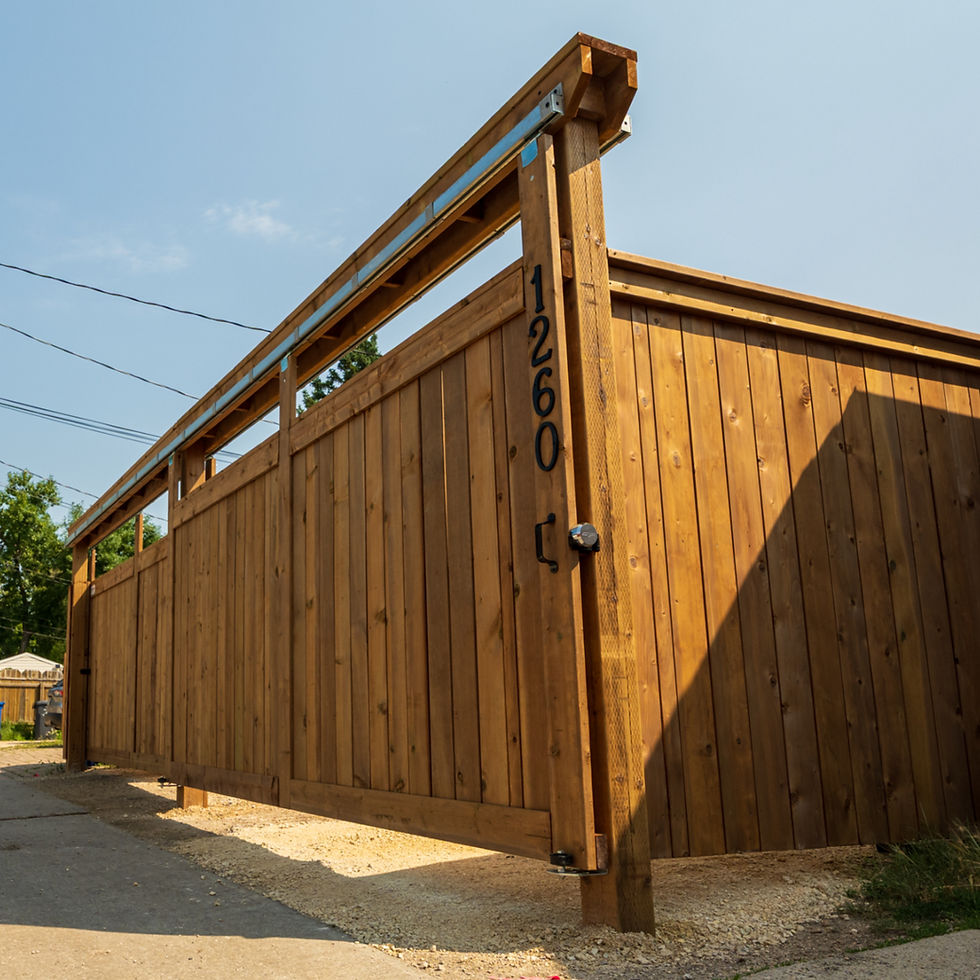
Full privacy where you sit, something lower and more open where the yard faces the street, chain link along the run behind the garage that nobody looks at. Carry the same post detail and the same height logic through, and it reads as one deliberate scheme, not a patchwork. If you want to see how the three main materials compare head to head first, that is covered in wood versus chain link versus ornamental.
Real Scenarios: Which One Sounds Like You?
You have a dog, and that is basically the whole reason.
Then containment drives everything. Height, gap at the base, and how the gate latches all matter more than style. If barking at passersby is part of the problem, visual screening becomes part of the containment answer rather than a separate want.
Your yard is overlooked from one specific direction.
Solve that one run properly and leave the rest lighter. This is the single most common case where people overbuild the entire perimeter for a problem that exists on one side.
You want the property to look finished more than anything else.
Then the visible runs deserve the attention and the budget, and the hidden runs can be simpler. It is a completely legitimate way to prioritize, and it produces a better result than spreading everything evenly.
You share the line with a neighbour who has opinions.
Have that conversation before you have the design conversation. A shared run built to one agreed spec beats two fences back to back, and the discussion is much easier before anyone has fallen in love with a style.
Frequently Asked Questions
How tall should my fence be?
Tall enough for what it is containing and screening, and within whatever the City allows for your property. Confirm the rules that apply to you directly with the City rather than relying on what a neighbour built.
Which way should the good side face?
Traditionally, the finished side faces out toward the neighbour or the street. A board-on-board build sidesteps the question entirely because it looks the same from both sides.
Is horizontal or vertical better?
Neither is better structurally when both are built properly. It is an aesthetic decision, and horizontal tends to suit newer homes while vertical suits older ones. Build whichever you will still like in ten years.
Should I fence the whole property?
Only if you need to. Fencing the area you use to a proper standard is almost always a better outcome than fencing every boundary to a lower one.
Does the fence style affect how long it lasts?
Far less than how it is built. Post depth, drainage and lumber quality are what decide lifespan in Manitoba. Style decides how it looks while it is doing that.
What if I genuinely do not know what I want?
That is normal, and it is fine. Answer the containment and screening questions honestly, and the rest tends to resolve itself during a walk around the yard.
Choosing a Fence in Winnipeg? Let's Start With the Yard, Not the Catalogue
I would rather spend twenty minutes working out what your fence is genuinely for than send you a quote for the thing you happened to mention on the phone. If you are planning a new wood fence anywhere in Winnipeg or Southern Manitoba, get in touch, and we will work through it run by run. That would be me asking the questions.
Antoine Leblanc
A+ Fences | Surround Yourself with Quality
204-250-8246